Mammals
Eurasian Beaver
Castor fiber · Castor
Romania's largest rodent, reintroduced between 1998 and 2003 and now spreading along rivers.
At a glance
- Status in Romania
- Resident
- Habitat
- Wetland
- Activity
- Evening · Night
- Diet
- Herbivorous. In winter mainly woody vegetation (willow, poplar, birch under 10 cm diameter) gathered in autumn and stored in the water; in summer prefers herbaceous plants when available.
- Conservation status
- Least Concern (IUCN)
- Photography difficulty
- Difficult
Photography Guide
Practical starting points based on the species’ behaviour and habitat, not fixed rules.
- Where and how to look
- Felled willows, gnawed stumps and slides on wooded riverbanks; watch quietly at dusk.
- Best time / activity
- Evening · Night
- Behaviour to anticipate
- Animals surfacing near the bank at dusk.
- Photography difficulty
- Difficult
- Fieldcraft
- Sit downwind on the bank before dusk and stay still; beavers slap the water and dive when alarmed.
- Ethics
- Stay off lodges and burrows, keep well back from the bank edge, and never use lights at close range.
Identification
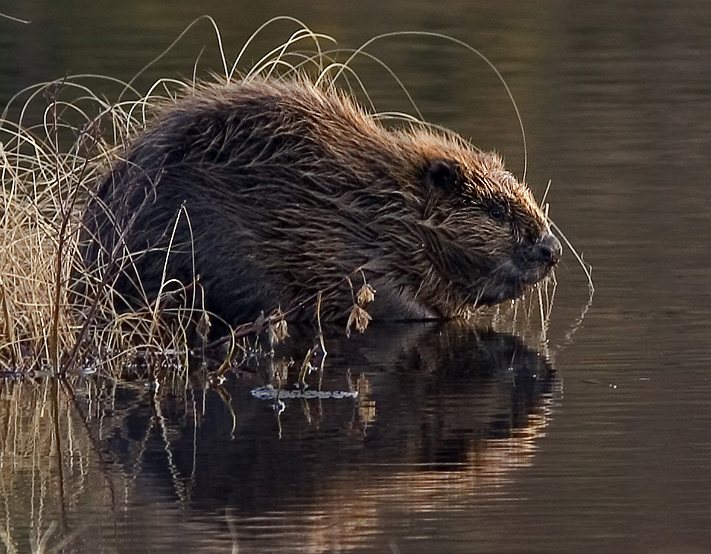
Very large rodent with a broad, flat, scaly tail, webbed hind feet, small eyes and ears and large yellow-orange incisors. Fur yellowish-brown to almost black, most often reddish-brown.
Habitat
A variety of freshwater systems — permanent and branching rivers, lakes, oxbows, ponds and canals with small level changes — with banks suitable for burrows, preferring woody vegetation such as poplar, willow and alder near the water.
Distribution
Reintroduced in 1998–2003 in the Olt, Mureș and Ialomița basins. The range also includes parts of the Someș and Tisa and the Danube Delta, and is expanding.
Approximate range in Romania
Diet
Herbivorous. In winter mainly woody vegetation (willow, poplar, birch under 10 cm diameter) gathered in autumn and stored in the water; in summer prefers herbaceous plants when available.
Behaviour
Mostly active at night. Monogamous, living in family colonies.
Seasonality in Romania
Monthly presence has not yet been source-verified.
Breeding
Breeds once a year in early spring (January–February); usually 1–3 young.