Mammals
European Ground Squirrel
Spermophilus citellus · Popândău
A small, colonial grassland rodent that is active by day and hibernates through winter.
At a glance
- Status in Romania
- Resident
- Habitat
- Meadow
- Activity
- Morning · Daytime · Evening
- Diet
- Both plant and animal food — over 200 plant species, mainly grasses, legumes and composites; insects in spring and summer.
- Conservation status
- Endangered (IUCN)
- Photography difficulty
- Moderate
Photography Guide
Practical starting points based on the species’ behaviour and habitat, not fixed rules.
- Where and how to look
- Short-grazed pastures and grassy dykes in the lowlands on warm, sunny mornings from spring to late summer.
- Best time / activity
- Morning · Daytime · Evening
- Behaviour to anticipate
- Animals standing upright on alert at the burrow entrance.
- Photography difficulty
- Moderate
- Fieldcraft
- Lie low at a distance and wait; animals that dive underground usually reappear if you stay still.
- Ethics
- Do not dig at, block or stand on burrows and nests, never bait, and avoid handling nest boxes.
Identification
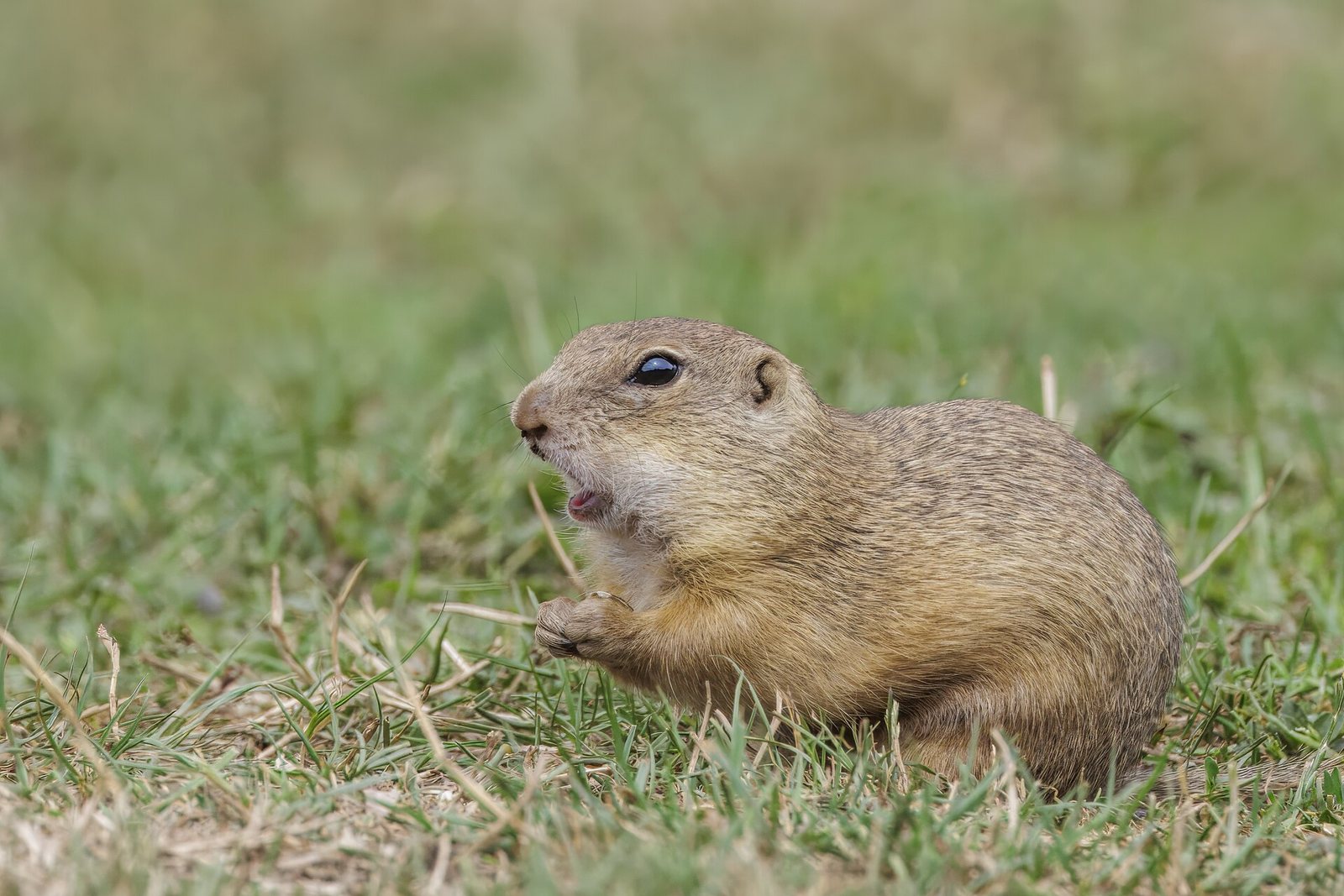
Small, sandy-brown ground squirrel with large eyes, small ears and a short tail; often stands upright at its burrow.
Habitat
Short steppe grassland and similar habitats: grassy land, grazed commons, meadows, crops (especially perennial fodder such as lucerne and clover), gardens, orchards, ravines, dykes and country road edges. Light grazing is important at most Romanian sites.
Distribution
Discontinuous: absent from the Transylvanian Plateau. Found outside the Carpathian arc in Moldavia, Muntenia, Oltenia, Dobrogea, Banat and Crișana, up to about 450 m.
Approximate range in Romania
Diet
Both plant and animal food — over 200 plant species, mainly grasses, legumes and composites; insects in spring and summer.
Behaviour
Strictly diurnal and sun-loving; feeds mainly in the morning (around 8–11) and in the afternoon before sunset. Lives in colonies, each animal with its own burrow. Hibernates from October to April.
Seasonality in Romania
Monthly presence has not yet been source-verified.
Breeding
Breeding starts a few days after emerging from hibernation — in March in the south, late March to mid-April in the north.