Birds
Black Redstart
Phoenicurus ochruros · Codroș de munte
A small dark chat with a rust-red tail, originally a bird of rocky slopes that now also breeds on buildings in towns and villages.
At a glance
- Status in Romania
- Migratory
- Habitat
- Mountain / Urban
- Activity
- Morning · Daytime · Evening
- Diet
- Mainly invertebrates and their larvae, especially in the breeding season; also berries outside it.
- Conservation status
- Least Concern (IUCN)
- Photography difficulty
- Easy to observe
Photograph this species
- Best time / activity
- Morning · Daytime · Evening
- Photography difficulty
- Easy to observe
- Where to look
- Listen at dawn for a male singing from a roof or rocky outcrop, in villages, towns, quarries and mountain rocks.
Photography Guide
Practical starting points based on the species’ behaviour and habitat, not fixed rules.
- Where and how to look
- Listen at dawn for a male singing from a roof or rocky outcrop, in villages, towns, quarries and mountain rocks.
- Best time / activity
- Morning · Daytime · Evening
- Behaviour to anticipate
- Males singing from the same high perch and short flycatching sallies.
- Photography difficulty
- Easy to observe
- Starting shutter speed
- 1/1000 sec or faster.
- Fieldcraft
- Find the song perch and wait at a distance; the bird usually returns to it.
- Ethics
- Do not approach nests in buildings or rock crevices, and never use playback.
Identification
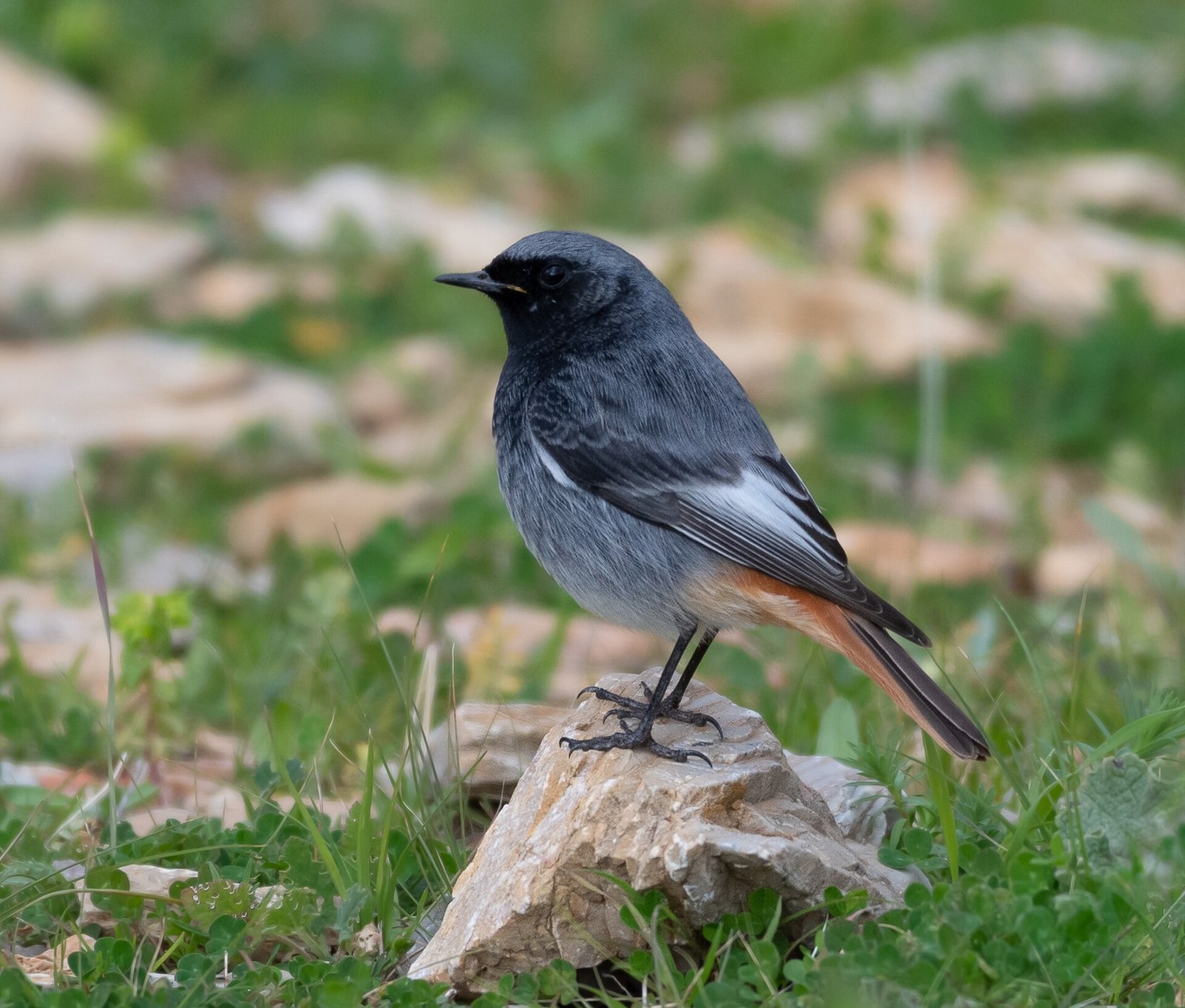
Small songbird, 13–14.5 cm. Adult males are grey-black with a white wing patch and a rust-red tail; females are grey-brown with the same rust-red tail. Most first-year males look like females.
Habitat
Originally rocky slopes and dwarf pine up to the alpine zone; it has adapted to buildings, churches, industrial sites, quarries and ruins.
Distribution
Present across almost the whole country, except forested areas and lowland regions dominated by extensive arable land.
Approximate range in Romania
Diet
Mainly invertebrates and their larvae, especially in the breeding season; also berries outside it.
Behaviour
Males sing loudly from a high perch such as a roof or an antenna, often at first light.
Seasonality in Romania
Breeds in Romania and is a short-distance migrant. Many birds winter, especially in the south of the country.
Monthly presence has not yet been source-verified.
Breeding
Breeds from late April to mid-July, with one or two broods a year of 5–7 eggs. The cup nest is placed on ledges, beams, rock crevices or niches in building walls.