Birds
Eurasian Reed Warbler
Acrocephalus scirpaceus · Lăcar de stuf
A plain brown warbler that lives almost entirely in reedbeds.
At a glance
- Status in Romania
- Summer visitor
- Habitat
- Wetland
- Activity
- Morning · Daytime
- Diet
- Mainly insects and other invertebrates; berries in late summer and autumn.
- Conservation status
- Least Concern (IUCN)
- Photography difficulty
- Moderate
Photography Guide
Practical starting points based on the species’ behaviour and habitat, not fixed rules.
- Where and how to look
- Reedbed edges along lakes and canals from May.
- Best time / activity
- Morning · Daytime
- Photography difficulty
- Moderate
- Fieldcraft
- Wait for the bird to climb to the top of a reed stem while singing.
- Ethics
- Keep away from nests, do not use playback in the breeding season, and let the bird decide how close it comes.
Identification
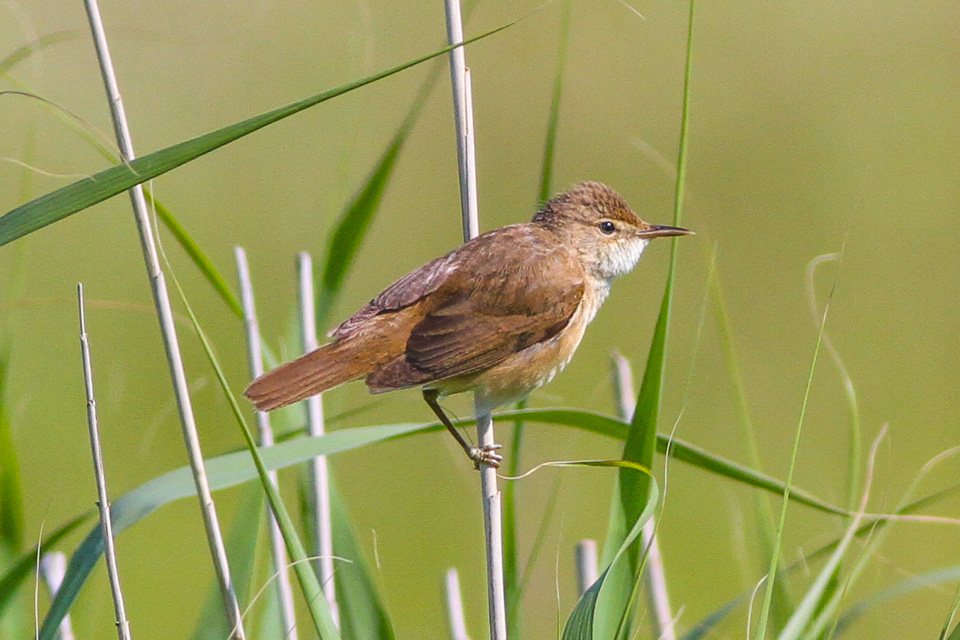
Plain warm-brown warbler with a pale throat, sloping forehead and fairly long bill.
Habitat
Extensive, dense reedbeds, usually by lowland waters; also feeds in adjacent habitats.
Distribution
Across Romania from the plains to the high hills, most abundant in large reedbeds.
Approximate range in Romania
Diet
Mainly insects and other invertebrates; berries in late summer and autumn.
Behaviour
Clambers up and down reed stems while singing a steady, chattering song.
Seasonality in Romania
Breeds in Romania and is migratory. Arrives in April and leaves in August–September; winters in Africa south of the Sahara (Sahel).
- JanUnknown
- FebUnknown
- MarUnknown
- AprPresent
- MayPresent
- JunPresent
- JulPresent
- AugPresent
- SepUnknown
- OctUnknown
- NovUnknown
- DecUnknown
Source-verified months inform the seasonal filters. Local timing can vary. Unconfirmed months do not imply absence. * Event timing retained from the earlier entry, not yet source-verified.
Breeding
Breeds from May to July; 3–5 eggs incubated for 10–12 days.