Birds
Eurasian Stone-curlew
Burhinus oedicnemus · Pasărea ogorului
A shy, well-camouflaged, large-eyed bird of dry open ground that hunts at night, breeding in the North Dobrogea Plateau.
At a glance
- Status in Romania
- Summer visitor
- Habitat
- Meadow
- Activity
- Evening · Night
- Diet
- Insects and larvae, snails, earthworms, frogs, seeds, small mammals and birds.
- Conservation status
- Least Concern (IUCN)
- Photography difficulty
- Difficult
Photograph this species
- Best time / activity
- Evening · Night
- Photography difficulty
- Difficult
- Where to look
- Listen at dusk and at night over dry, sparsely vegetated ground and fields in North Dobrogea.
Photography Guide
Practical starting points based on the species’ behaviour and habitat, not fixed rules.
- Where and how to look
- Listen at dusk and at night over dry, sparsely vegetated ground and fields in North Dobrogea.
- Best time / activity
- Evening · Night
- Behaviour to anticipate
- Birds standing still or running low in the last light of the day.
- Photography difficulty
- Difficult
- Starting shutter speed
- 1/500 sec or faster; raise ISO as light falls.
- Fieldcraft
- Use a vehicle as a hide on tracks and scan slowly; the camouflage is excellent.
- Ethics
- Never walk across fields to find nests or chicks on the ground, and never use playback.
Identification
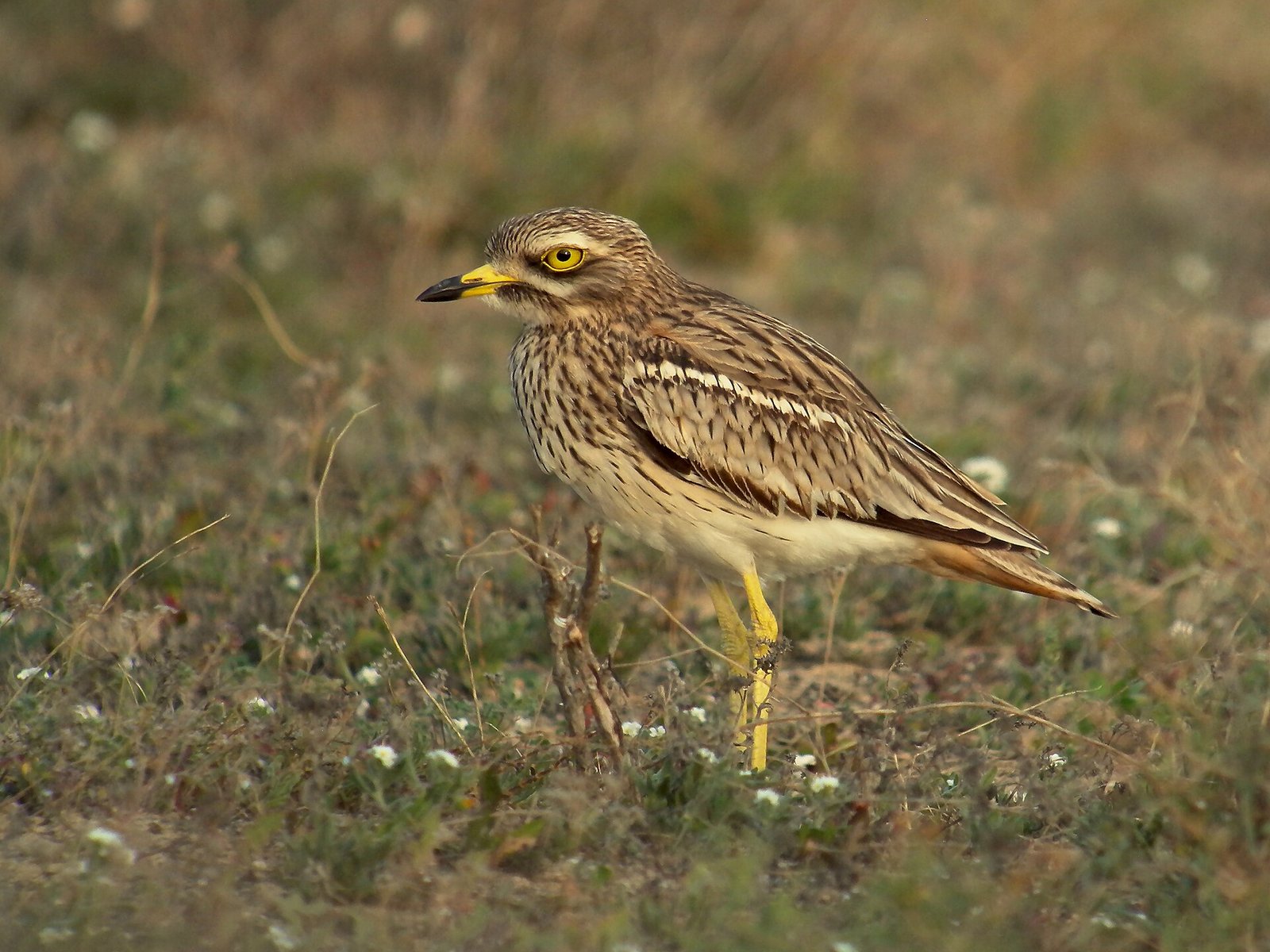
38–45 cm long with a wingspan of about 76–88 cm. Plumage the colour of dry grass, with white stripes and spots on the wings, large yellow eyes adapted to night life and yellow legs. Sexes look alike.
Habitat
Areas with sparse vegetation or farmland crops, where it nests in a shallow scrape.
Distribution
Breeds in the North Dobrogea Plateau; a conservation target in ROSPA0091 Pădurea Babadag, ROSPA0100 Stepa Casimcea and ROSPA0040 Dunărea Veche–Brațul Măcin.
Approximate range in Romania
Diet
Insects and larvae, snails, earthworms, frogs, seeds, small mammals and birds.
Behaviour
Hard to see: it runs with its head drawn in and hunts at night. Shy and wary; when surprised it can lie flat with its neck stretched out. During the breeding season its calls are often heard at night.
Seasonality in Romania
A migrant that winters in Africa and arrives to breed in the North Dobrogea Plateau at the end of March.
Monthly presence has not yet been source-verified.
Breeding
The nest is a scrape in the ground, lightly lined with plant debris and small stones. Both partners incubate, and a lost clutch may be replaced with a second one.