Birds
Eurasian Three-toed Woodpecker
Picoides tridactylus · Ciocănitoare de munte
A dark mountain woodpecker of spruce and fir forests, closely tied to insect-infested dead trees.
At a glance
- Status in Romania
- Resident
- Habitat
- Forest / Mountain
- Activity
- Morning · Daytime
- Diet
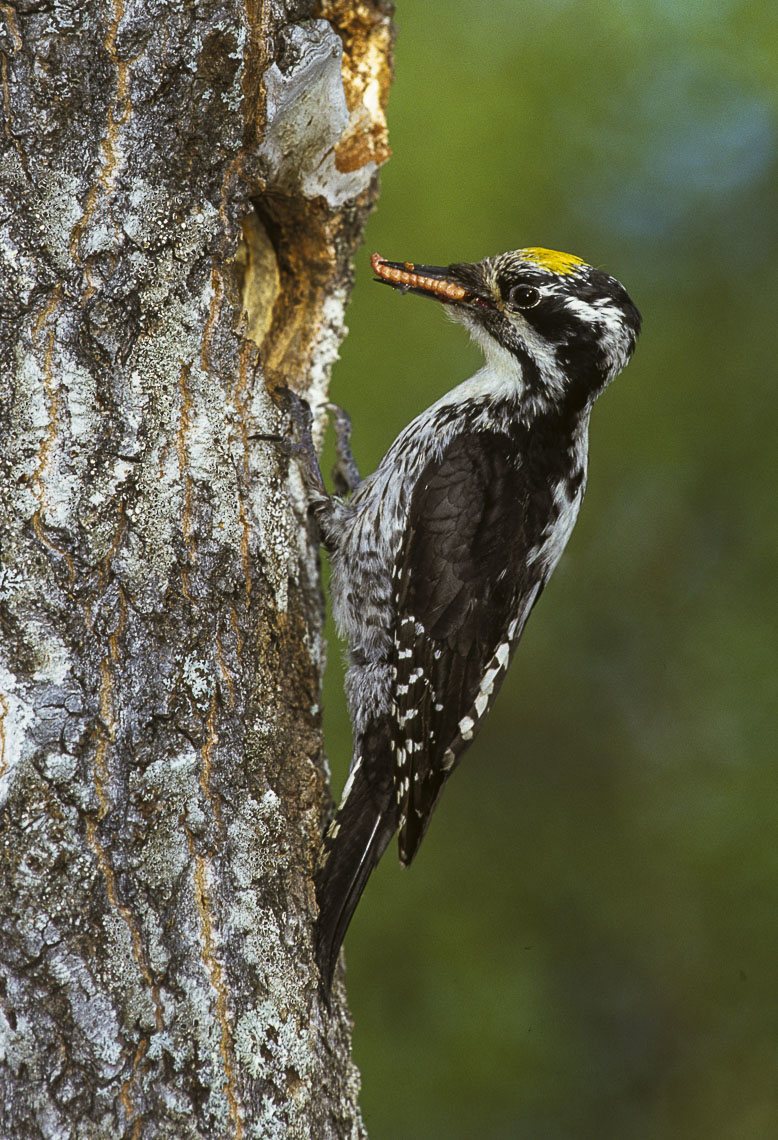
- Mainly beetle larvae and pupae taken by stripping conifer bark; also sap, spruce seeds and fruit.
- Conservation status
- Least Concern (IUCN)
- Photography difficulty
- Difficult
Photography Guide
Practical starting points based on the species’ behaviour and habitat, not fixed rules.
- Where and how to look
- Spruce forest with dead trees and windthrow in the Carpathians.
- Best time / activity
- Morning · Daytime
- Behaviour to anticipate
- Woodpeckers usually work their way up a trunk; watch where the bird lands and wait for it to turn its head.
- Photography difficulty
- Difficult
- Starting shutter speed
- Around 1/1000 sec on the trunk; 1/2000 sec or faster when it flies off.
- Fieldcraft
- Follow drumming and calls, then stay still at a distance and let the bird come round the trunk into view.
- Ethics
- Never wait beside an occupied nest hole, never use playback, and move on if the birds stop feeding or start alarm-calling.
Identification
Dark woodpecker with a white stripe down the back and barred flanks; the male has a yellow crown and there is no red in the plumage.
Habitat
Mountain conifer forest, especially fir and spruce with dead, insect-infested trees and windthrow areas.
Distribution
All high mountain areas with conifer forest; absent from the Măcin Mountains.
Approximate range in Romania
Diet
Mainly beetle larvae and pupae taken by stripping conifer bark; also sap, spruce seeds and fruit.
Behaviour
Rings trees with rows of small holes to drink sap.
Seasonality in Romania
Breeds in Romania and is resident.
- JanPresent
- FebPresent
- MarPresent
- AprPresent
- MayPresent
- JunPresent
- JulPresent
- AugPresent
- SepPresent
- OctPresent
- NovPresent
- DecPresent
Source-verified months inform the seasonal filters. Local timing can vary. Unconfirmed months do not imply absence. * Event timing retained from the earlier entry, not yet source-verified.
Breeding
Lays 3–6 eggs from mid-May, incubated by both parents for 11–14 days.