Birds
European Honey Buzzard
Pernis apivorus · Viespar
A buzzard-sized raptor that feeds mainly on wasps and bees, listed as a conservation target in Babadag Forest and the Casimcea Steppe.
At a glance
- Status in Romania
- Summer visitor
- Habitat
- Forest
- Activity
- Morning · Daytime
- Diet
- Larvae and adults of insects, especially wasps and bees, plus rodents, birds, lizards and snakes.
- Conservation status
- Least Concern (IUCN)
- Photography difficulty
- Difficult
Photograph this species
- Best time / activity
- Morning · Daytime
- Photography difficulty
- Difficult
- Where to look
- From May, watch over woodland and its edges for a buzzard-like raptor soaring on thermals.
Photography Guide
Practical starting points based on the species’ behaviour and habitat, not fixed rules.
- Where and how to look
- From May, watch over woodland and its edges for a buzzard-like raptor soaring on thermals.
- Best time / activity
- Morning · Daytime
- Behaviour to anticipate
- Soaring birds over woodland edges in warm weather.
- Photography difficulty
- Difficult
- Starting shutter speed
- 1/2000 sec or faster for flight.
- Fieldcraft
- Find a viewpoint over forest edges and scan the sky; check every 'buzzard' closely.
- Ethics
- Keep well away from nests and never disclose nest sites; watch from a distance and leave if the bird changes behaviour because of you.
Identification
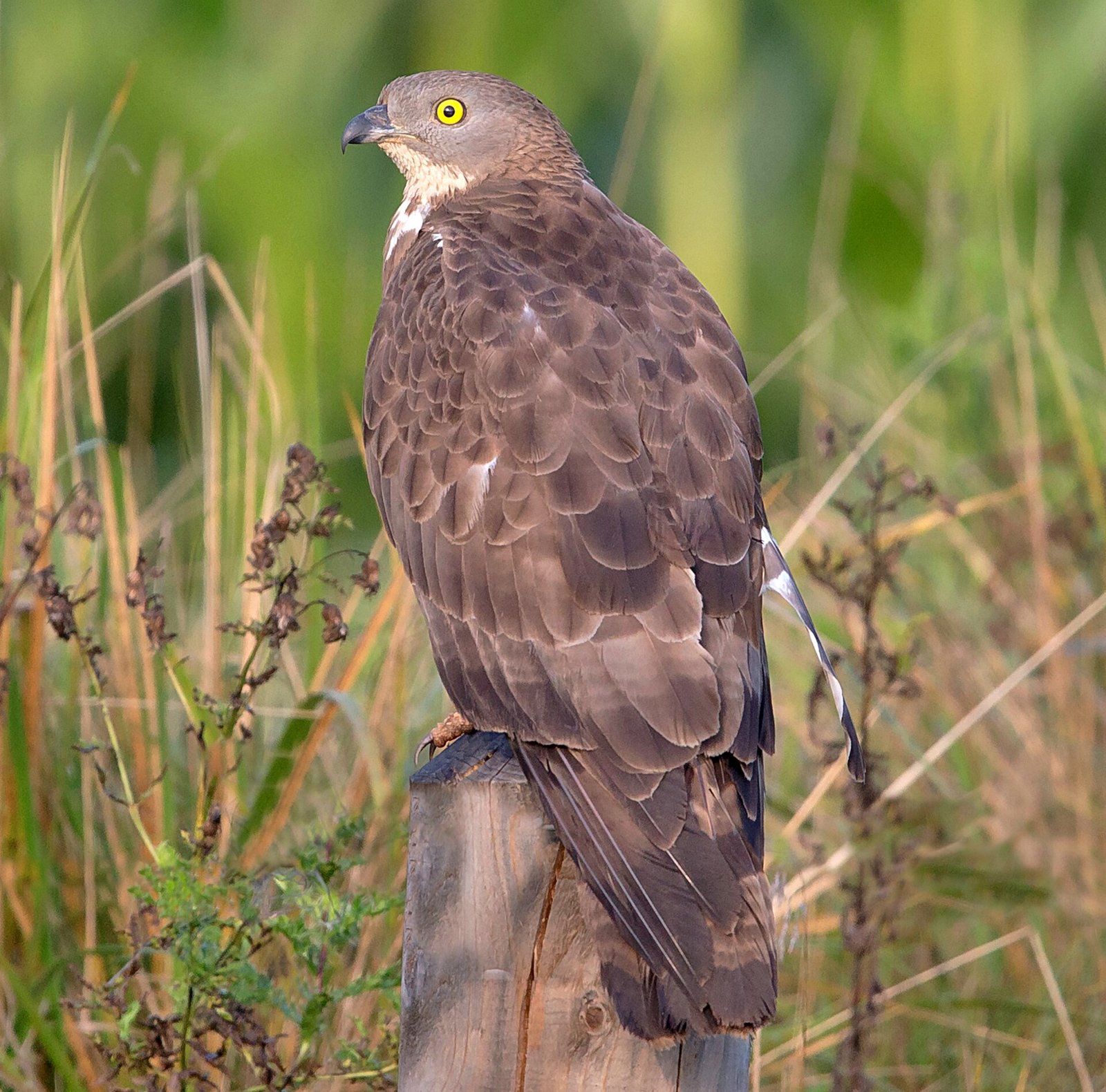
52–59 cm long with a 113–135 cm wingspan, slightly larger than the Common Buzzard and easily confused with it at a distance. Unusually for a large raptor, the sexes differ: the male has a blue-grey head, the female a brown one, and females are generally darker.
Habitat
Wooded areas with trees for nesting; often uses old Rook nests.
Distribution
A conservation target in the ROSPA0091 Pădurea Babadag and ROSPA0100 Stepa Casimcea Natura 2000 sites in North Dobrogea.
Approximate range in Romania
Diet
Larvae and adults of insects, especially wasps and bees, plus rodents, birds, lizards and snakes.
Behaviour
Soars on thermals in a characteristic posture. Usually flies low and perches on branches with the body held horizontal and the tail hanging down.
Seasonality in Romania
A migrant that winters in Africa and arrives from the wintering grounds at the beginning of May.
Monthly presence has not yet been source-verified.
Breeding
Both parents build the nest; the female does most of the incubation.