Birds
Great Cormorant
Phalacrocorax carbo · Cormoran mare
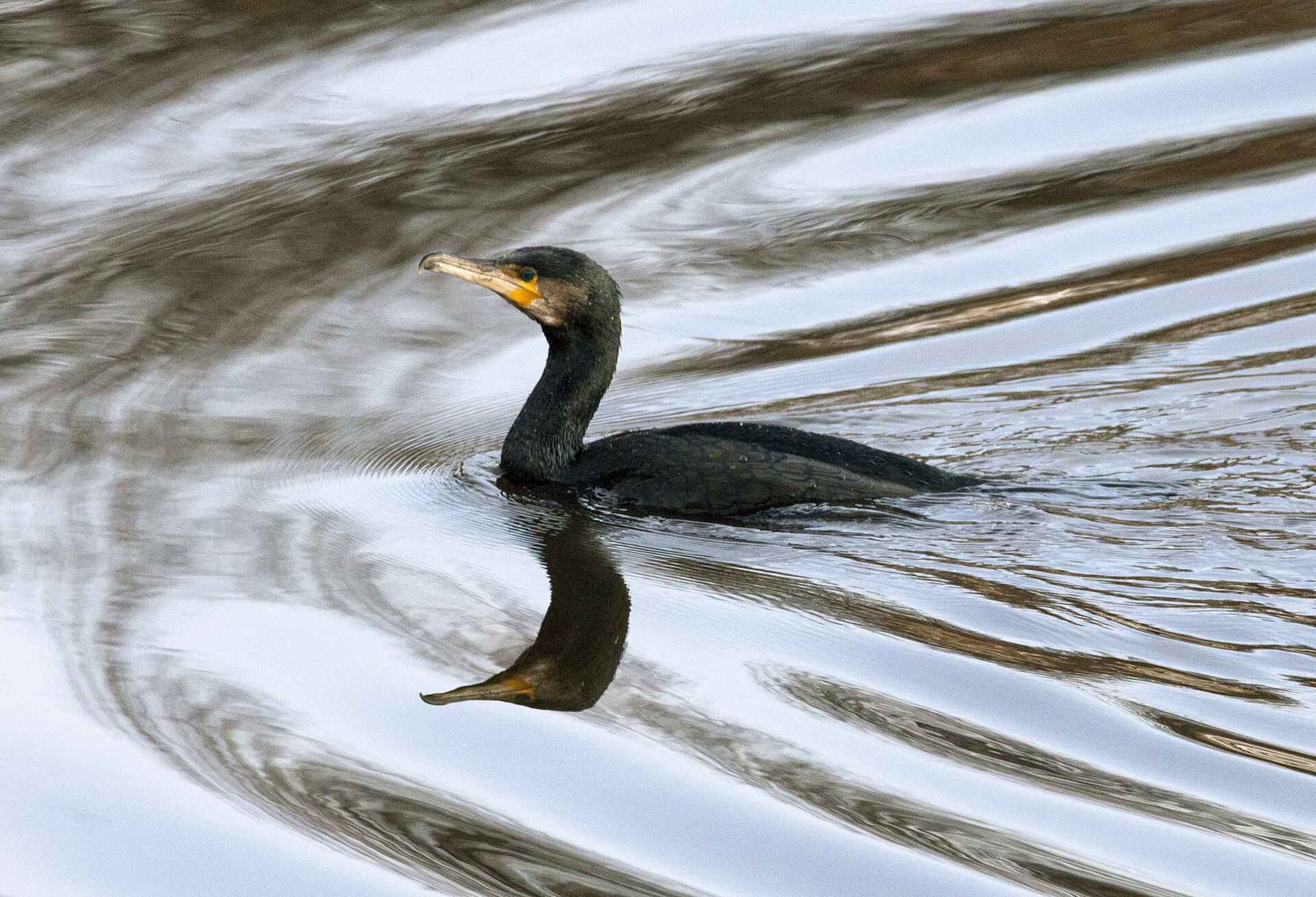
A large, dark fish-eating waterbird, often seen standing with its wings held open to dry.
At a glance
- Status in Romania
- Resident
- Habitat
- Wetland
- Activity
- Morning · Daytime · Evening
- Diet
- Mainly fish, usually 10–20 cm long, caught by diving.
- Conservation status
- Least Concern (IUCN)
- Photography difficulty
- Easy to observe
Identification
Large and black with a bronze sheen, a hooked bill and white on the face. Breeding adults show white thigh patches.
Habitat
Large low-altitude wetlands: mosaics of lakes and slow rivers with reedbeds, nesting in trees or shrubs within the vegetation.
Distribution
Breeds mainly in the wetlands of the east and south-east, especially the Danube Delta and large rivers; scattered elsewhere. Disperses widely in winter.
Approximate range in Romania
When it is active
Morning · Daytime · Evening
Diet
Mainly fish, usually 10–20 cm long, caught by diving.
Behaviour
Nests in colonies. Rests on trees, posts and sandbanks, often in groups.
Seasonality in Romania
Breeds in Romania and is resident. In winter it disperses and can be seen in variable numbers on many water bodies.
- JanPresent
- FebPresent
- MarPresent
- AprPresent
- MayPresent
- JunPresent
- JulPresent
- AugPresent
- SepPresent
- OctPresent
- NovPresent
- DecPresent
Source-verified months inform the seasonal filters. Local timing can vary. Unconfirmed months do not imply absence. * Event timing retained from the earlier entry, not yet source-verified.
Breeding
Breeding begins in April. A clutch of 2–6 eggs is incubated for 27–31 days.
How to find it
Large lakes, the Danube and the Delta; flocks fly low over the water at dawn and dusk.
Photography
General guidance based on the species’ behaviour, not a report of Nick’s personal field experience.
- Difficulty
- Easy to observe
- Behaviour to anticipate
- The wing-drying pose after fishing, and birds running across the water to take off.
- Starting shutter speed
- 1/1600–1/2500 sec for flight.
- Ethics
- Keep away from breeding colonies.
Practical starting points, not fixed rules.