Birds
Hazel Grouse
Tetrastes bonasia · Ierunca
A small, secretive forest grouse of the Carpathians, more often heard than seen.
At a glance
- Status in Romania
- Resident
- Habitat
- Forest / Mountain
- Activity
- Morning · Evening
- Diet
- Mainly plant food: in winter seeds, catkins, buds and twigs of alder, birch or hazel; in spring leaves and flowers.
- Conservation status
- Least Concern (IUCN)
- Photography difficulty
- Difficult
Photography Guide
Practical starting points based on the species’ behaviour and habitat, not fixed rules.
- Where and how to look
- Damp forest valleys with alder, birch and berry bushes in the mountains.
- Best time / activity
- Morning · Evening
- Photography difficulty
- Difficult
- Fieldcraft
- Walk slowly on forest tracks at dawn and scan the ground and low branches ahead.
- Ethics
- Do not search for nests or broods; flushing a hen leaves eggs and chicks exposed.
Identification
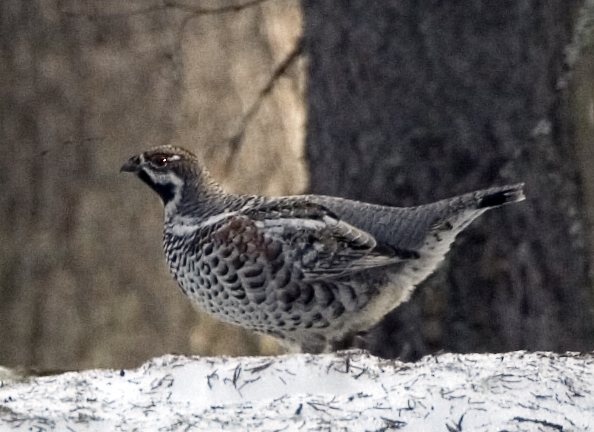
Small grouse with intricate grey, brown and white plumage and a small crest; the male has a black throat.
Habitat
Compact conifer and mixed forest, preferring damp woods with dense undergrowth, scattered spruce and slightly more open valleys rich in raspberry, bramble or other shrubs.
Distribution
Tied to the Carpathian chain, in forested mountain areas from about 600 m upwards.
Approximate range in Romania
Diet
Mainly plant food: in winter seeds, catkins, buds and twigs of alder, birch or hazel; in spring leaves and flowers.
Behaviour
Relies on camouflage and often freezes before flushing at close range.
Seasonality in Romania
Breeds in Romania and is resident.
- JanPresent
- FebPresent
- MarPresent
- AprPresent
- MayPresent
- JunPresent
- JulPresent
- AugPresent
- SepPresent
- OctPresent
- NovPresent
- DecPresent
Source-verified months inform the seasonal filters. Local timing can vary. Unconfirmed months do not imply absence. * Event timing retained from the earlier entry, not yet source-verified.
Breeding
Breeding starts in April–May; usually 7–11 eggs in a nest at the base of a shrub or under a fallen tree; incubation 23–27 days.