Birds
Mallard
Anas platyrhynchos · Rață mare
The most familiar duck in Romania, found on almost any kind of water, from the Danube Delta to city park lakes.
At a glance
- Status in Romania
- Resident
- Habitat
- Wetland / Urban
- Activity
- Morning · Daytime · Evening
- Diet
- Omnivorous and opportunistic: aquatic plants and seeds, invertebrates and occasionally small fish, taken by dabbling at the surface or upending.
- Conservation status
- Least Concern (IUCN)
- Photography difficulty
- Easy to observe
Identification
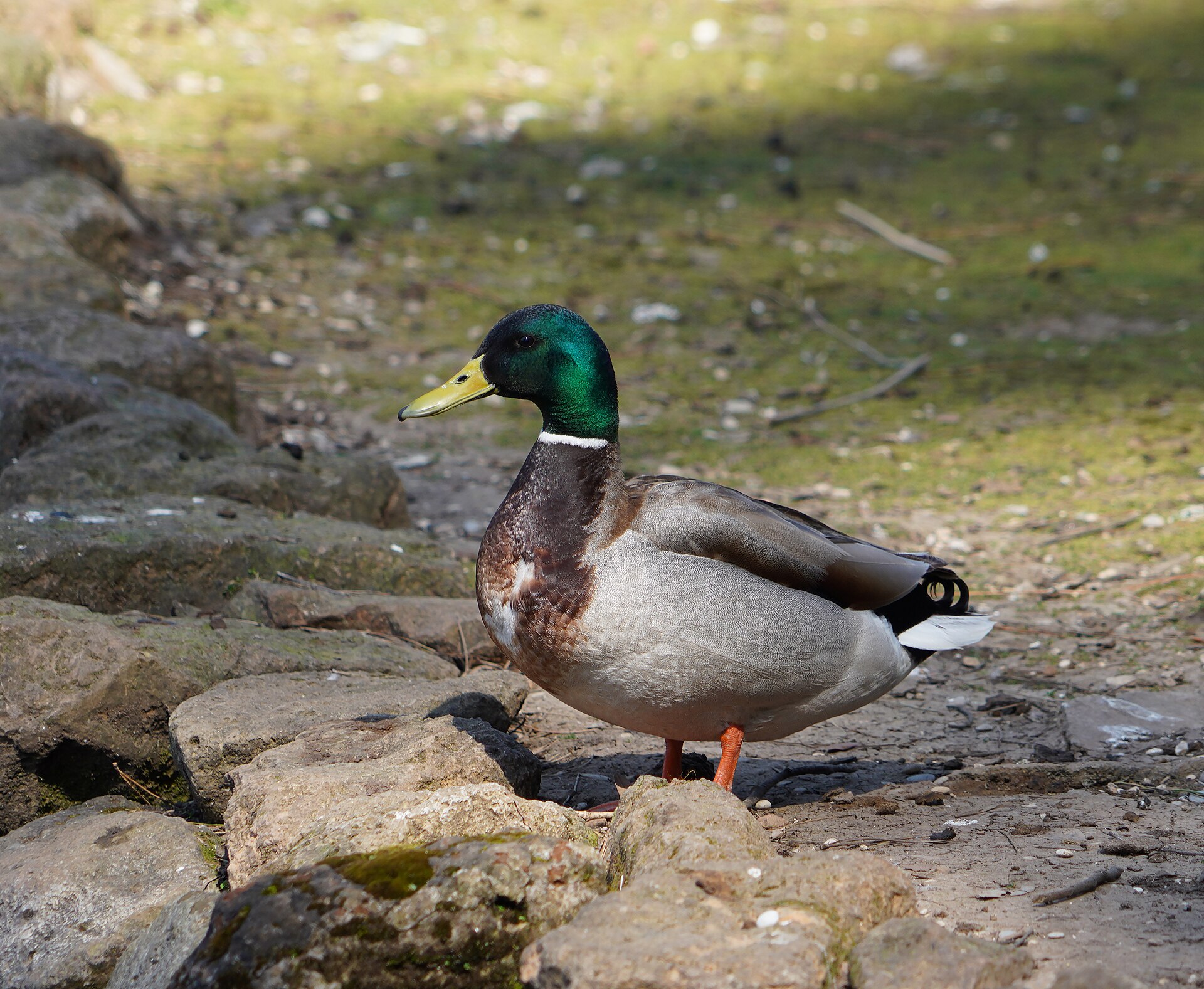
Large dabbling duck. The breeding male has a glossy green head, white neck ring, chestnut breast and grey body; the female is mottled brown. Both show a blue wing patch bordered with white.
Habitat
Almost any wetland: large lakes and the Delta, isolated ponds, river banks, canals and lakes in towns.
Distribution
Breeds throughout Romania, from the Danube Delta up to the submontane zone.
Approximate range in Romania
When it is active
Morning · Daytime · Evening
Diet
Omnivorous and opportunistic: aquatic plants and seeds, invertebrates and occasionally small fish, taken by dabbling at the surface or upending.
Behaviour
Dispersed in pairs during breeding; forms large flocks on unfrozen water in autumn and winter.
Seasonality in Romania
Breeds in Romania and is present all year. Widely dispersed in the breeding season; in autumn and winter it gathers in large groups on water that does not freeze, joined by birds from further north.
- JanPresent
- FebPresent
- MarPresent
- AprPresent
- MayPresent
- JunPresent
- JulPresent
- AugPresent
- SepPresent
- OctPresent
- NovPresent
- DecPresent
Source-verified months inform the seasonal filters. Local timing can vary. Unconfirmed months do not imply absence. * Event timing retained from the earlier entry, not yet source-verified.
Breeding
Breeding can start as early as February, with egg-laying from the second half of March or early April.
How to find it
Any lake, river or park pond. Winter flocks are largest on water that stays ice-free.
Photography
General guidance based on the species’ behaviour, not a report of Nick’s personal field experience.
- Difficulty
- Easy to observe
- Behaviour to anticipate
- Take-off from water, wing flapping after bathing and courtship displays in winter.
- Starting shutter speed
- Around 1/1000 sec for swimming birds; 1/2000 sec or faster for take-off and flight.
- Fieldcraft
- A low angle close to the water level gives a more natural, intimate view.
- Ethics
- Do not feed bread to attract birds, and avoid flushing resting flocks.
Practical starting points, not fixed rules.