Birds
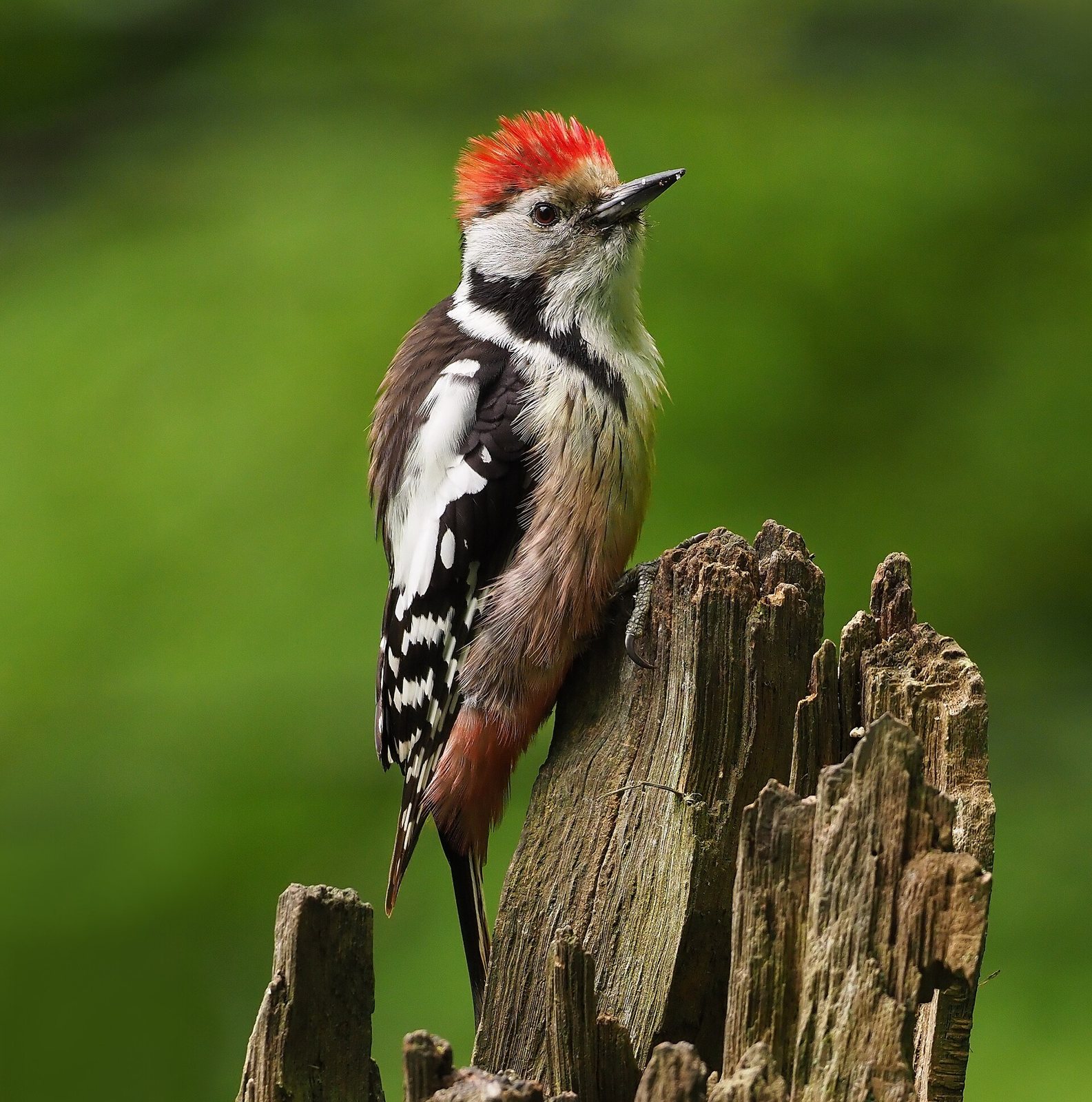
Middle Spotted Woodpecker
Leiopicus medius · Ciocănitoare de stejar
An oak-woodland specialist with a bright red crown, foraging on bark rather than drilling deep.
At a glance
- Status in Romania
- Resident
- Habitat
- Forest
- Activity
- Morning · Daytime
- Diet
- Invertebrates on and under bark: beetle larvae, caterpillars and aphids; occasionally buds.
- Conservation status
- Least Concern (IUCN)
- Photography difficulty
- Moderate
Photography Guide
Practical starting points based on the species’ behaviour and habitat, not fixed rules.
- Where and how to look
- Old oak woods; listen for its nasal calls in early spring.
- Best time / activity
- Morning · Daytime
- Behaviour to anticipate
- Woodpeckers usually work their way up a trunk; watch where the bird lands and wait for it to turn its head.
- Photography difficulty
- Moderate
- Starting shutter speed
- Around 1/1000 sec on the trunk; 1/2000 sec or faster when it flies off.
- Fieldcraft
- Follow drumming and calls, then stay still at a distance and let the bird come round the trunk into view.
- Ethics
- Never wait beside an occupied nest hole, never use playback, and move on if the birds stop feeding or start alarm-calling.
Identification
Pied woodpecker with a red crown in both sexes, a weak face pattern and a pinkish lower belly.
Habitat
Woods with oaks — pedunculate, downy and Hungarian oak, sessile oak — and riverside woods of poplar, willow and ash. Prefers mature trees.
Distribution
From the lowlands, including the Danube Delta, up to the high hills, but tied to woods with oaks.
Approximate range in Romania
Diet
Invertebrates on and under bark: beetle larvae, caterpillars and aphids; occasionally buds.
Behaviour
Searches the surface of bark and branches more than it drills.
Seasonality in Romania
Breeds in Romania and is resident with generally small movements; some birds move to lower areas in winter.
- JanPresent
- FebPresent
- MarPresent
- AprPresent
- MayPresent
- JunPresent
- JulPresent
- AugPresent
- SepPresent
- OctPresent
- NovPresent
- DecPresent
Source-verified months inform the seasonal filters. Local timing can vary. Unconfirmed months do not imply absence. * Event timing retained from the earlier entry, not yet source-verified.
Breeding
Breeding can start as early as February with eggs from April; usually 4–8 eggs, incubated by both parents for 11–14 days.