Birds
Osprey
Pandion haliaetus · Uligan pescar
A specialist fish-hunting raptor, white below and brown above, listed as a conservation target in the Dunărea Veche–Brațul Măcin protected area.
At a glance
- Status in Romania
- Summer visitor
- Habitat
- Wetland
- Activity
- Morning · Daytime · Evening
- Diet
- Mainly fish, plus small mammals, injured birds and frogs.
- Conservation status
- Least Concern (IUCN)
- Photography difficulty
- Difficult
Photograph this species
- Best time / activity
- Morning · Daytime · Evening
- Photography difficulty
- Difficult
- Where to look
- Watch over large open water from spring onwards for a large raptor hovering and plunging feet-first.
Photography Guide
Practical starting points based on the species’ behaviour and habitat, not fixed rules.
- Where and how to look
- Watch over large open water from spring onwards for a large raptor hovering and plunging feet-first.
- Best time / activity
- Morning · Daytime · Evening
- Behaviour to anticipate
- Hovering before the dive and the moment it rises from the water with a fish.
- Photography difficulty
- Difficult
- Starting shutter speed
- 1/2500 sec or faster for the plunge and take-off.
- Fieldcraft
- Work from the shore with a long lens; the action usually happens far out over the water.
- Ethics
- Keep well away from nests and never disclose nest sites; watch from a distance and leave if the bird changes behaviour because of you.
Identification
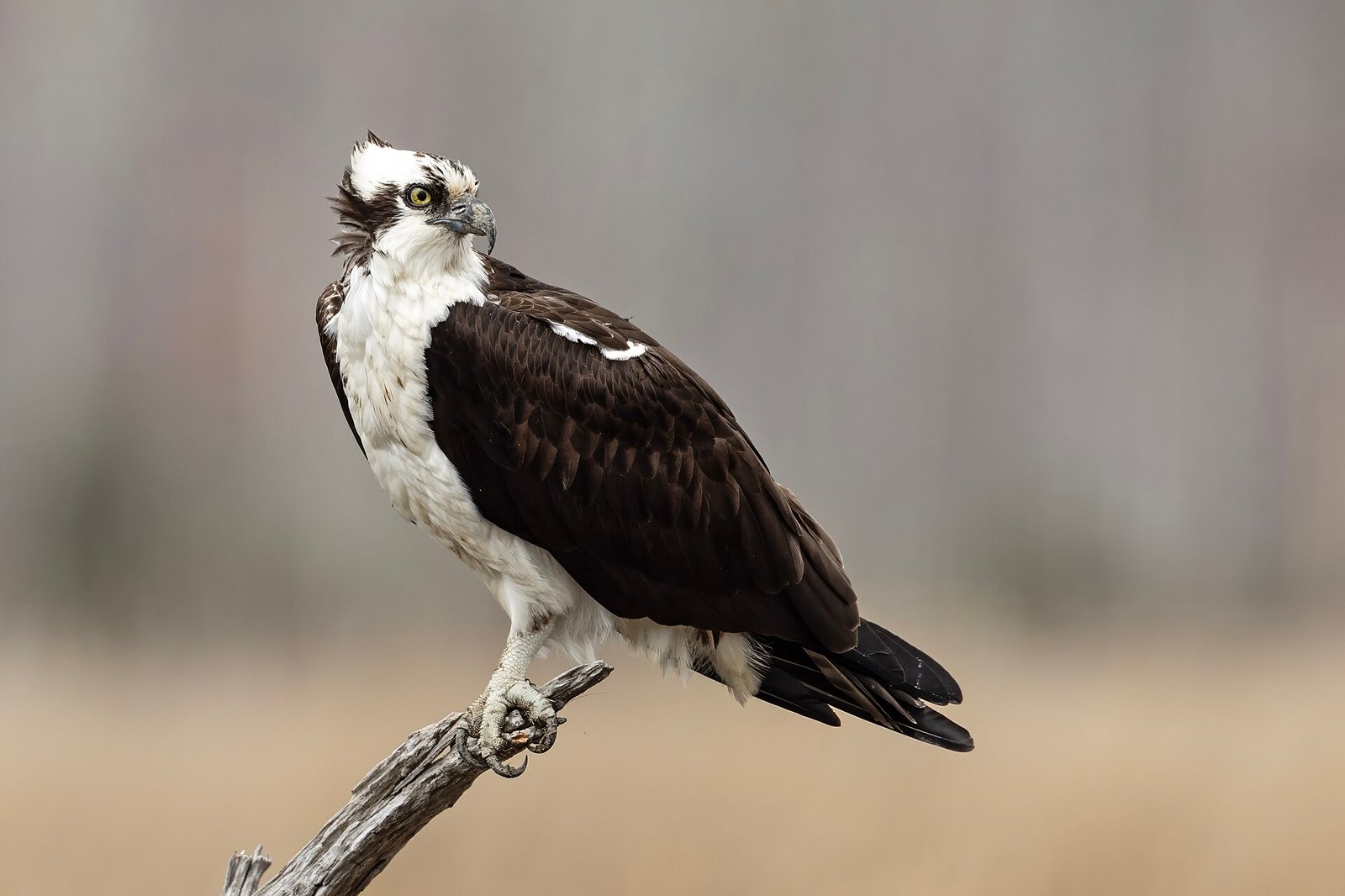
52–60 cm long with a 152–167 cm wingspan. Brown back, tail and wings; white head and body with a dark band through the eye. Sexes look alike.
Habitat
Wetlands with fish; the nest is placed on cliffs, in trees or on electricity pylons, 3–5 km from a wetland.
Distribution
A conservation target in the ROSPA0040 Dunărea Veche–Brațul Măcin Natura 2000 site in North Dobrogea.
Approximate range in Romania
Diet
Mainly fish, plus small mammals, injured birds and frogs.
Behaviour
Hunts by circling widely or hovering in place, 10–30 m above the fish, then plunges with wings half closed. It defends the nest but not the area around it, and may hunt up to 14 km away.
Seasonality in Romania
Winters in Africa and returns from the wintering grounds at the end of March or the beginning of April.
Monthly presence has not yet been source-verified.
Breeding
Monogamous for life. The stick nest is added to year after year and can reach 1 m high and 1 m across. Both partners incubate; during this time only the male hunts and feeds the female.